Agile Estimation Techniques: A Complete Guide
Agile estimation is the practice of sizing backlog items relative to each other rather than predicting their absolute duration - using a team's shared judgment, expressed through one of several structured techniques, to turn a vague backlog into a plannable one. Scrum Poker is the most widely used technique, but it isn't the only one, and picking the wrong technique for a situation wastes more time than a bad estimate ever does.
This guide covers the technique family: what relative estimation actually is, why it beats absolute-duration guessing, and a fair comparison of every major technique - so you can pick the right one instead of defaulting to whatever your last team used.
What relative estimation is, and why agile teams use it
Relative estimation asks "is this bigger or smaller than something we've already built?" instead of "how many hours will this take?" The distinction matters because of a genuine, well-documented human limitation: people are bad at predicting absolute durations for unfamiliar work, but consistently good at comparisons. Anyone who has moved house can tell you the sofa is harder to move than the lamp, with no idea how long either will actually take.
A simple worked example: imagine sizing "build a shed," "build a garage," and "build a house." Nobody needs construction experience to rank them by relative effort - shed, garage, house, in that order, with growing gaps between them. That ranking is more reliable than any one of the three people in the room guessing hours for a job they've never done. Agile estimation techniques are all, in one form or another, structured ways of producing that ranking as a team.
How accurate is agile estimation, really?
Honestly: individually, not very. The software-estimation research literature - much of it from Magne Jørgensen and colleagues at Simula Research Laboratory - documents persistent overconfidence and susceptibility to irrelevant anchors in software estimates generally. What the research also shows is that structured group estimation measurably outperforms both individual guesses and simple averaging of individual guesses - a group that argues about a story before committing produces a more realistic number than a group that silently submits guesses and averages them. That's the entire justification for every technique in this guide: the structure of the disagreement is what improves the estimate, not the arithmetic.
The cone of uncertainty
Every estimation technique on this page operates inside a constraint no technique can escape: estimates made early in a project are inherently less accurate than estimates made close to delivery, because less is known. Barry Boehm's "cone of uncertainty" (popularized further by Steve McConnell) describes this narrowing funnel - at the idea stage, a feature's true effort might be 4x or 0.25x the initial guess; by the time it's a sprint-ready story with acceptance criteria, that range has narrowed dramatically.
This is why the technique comparison below isn't really about which method is "most accurate" in the abstract - it's about matching technique precision to how far the cone has narrowed. Fine-grained Scrum Poker on a vague, six-months-out idea produces false precision; coarse t-shirt sizing on a sprint-ready story throws away information the team already has. Use the coarse techniques early in the cone, the precise ones late.
Where "ideal days" fits into the history
Before points became the norm, early Extreme Programming teams estimated in ideal days - the time a task would take with zero interruptions, meetings, or context-switching. The idea was sound (still relative-ish, still acknowledging real days aren't ideal days) but the unit caused a predictable problem: stakeholders heard "days" and read it as a calendar commitment, ignoring the word "ideal" entirely. Abstracting the unit into dimensionless story points removed that misreading at the cost of a slightly less intuitive number. Ideal days occasionally still show up for low-level task breakdowns inside a story, where the ambiguity matters less because nobody outside engineering sees the number.
The technique comparison
| Technique | What it optimizes for | Team size | Feeds velocity? |
|---|---|---|---|
| Scrum Poker | Discussion depth on sprint-ready stories | 4-7 ideal | Yes (points) |
| Relative estimation (general) | The underlying principle behind all of these | Any | Depends on scale used |
| T-shirt sizing | Speed over precision, roadmap-level | Any, incl. non-engineers | Only with a size-to-point mapping |
| Affinity estimation | Sizing a large backlog quickly | Any | With a mapping |
| Bucket system | Very large backlogs (50+ items) | Any | With a mapping |
| Dot voting | Prioritization, not sizing | Any | No - different purpose |
| Wideband Delphi | High-stakes, auditable estimates | Any, more formal | No, produces effort estimates directly |
| Three-point (PERT) | A confidence interval, not consensus | Individual or small group | No, feeds schedule math instead |
No single row is "correct." A team estimating ten sprint-ready stories with full context should use Scrum Poker. The same team sizing two hundred backlog items for a quarterly roadmap should use affinity estimation or the bucket system - running full poker rounds on two hundred items is how estimation becomes the thing everyone dreads.
Relative estimation techniques in detail
T-shirt sizing
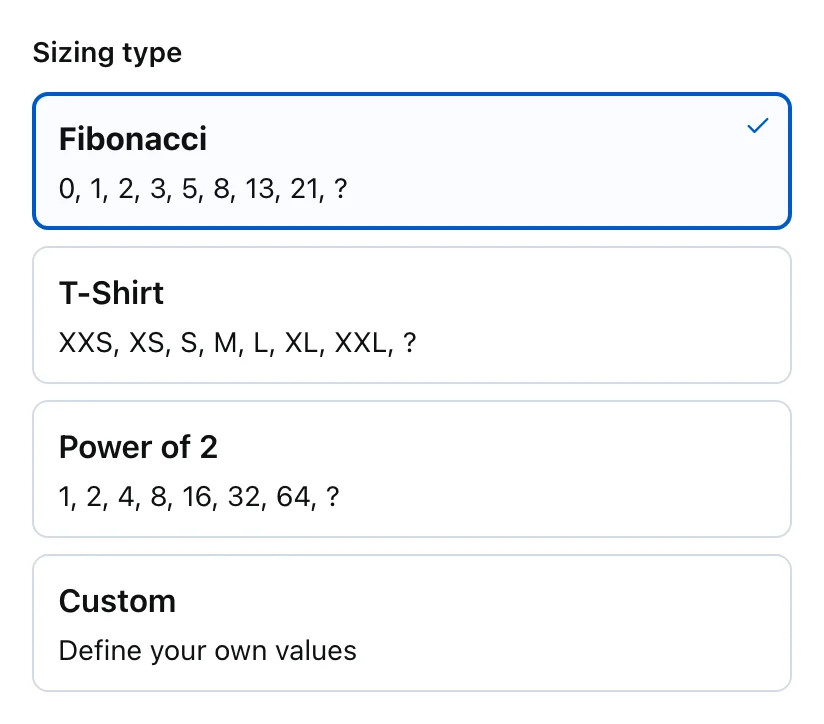
Trades precision for speed by replacing numbers with XS, S, M, L, XL, XXL. Nobody argues whether something is a 5 or an 8; they argue whether it's a Medium or a Large, which resolves faster because the categories are coarser. Best for early-stage roadmap grooming, and for rooms with non-engineers who find "Large" more intuitive than "8 story points." The trade-off: sizes don't sum into a velocity number without an agreed mapping (S=2, M=5, L=8...), and that mapping reintroduces some of the precision debate you were trying to avoid. Full comparison: Fibonacci vs t-shirt sizing and the t-shirt estimation tool.
Worked example: a product team roadmapping next quarter sizes 15 roadmap items in twenty minutes flat - "auth redesign" gets XL without debate, "add a tooltip" gets XS - because nobody needs to defend a precise number six months before any of it enters a sprint.
Affinity estimation
The team silently places story cards or sticky notes along a size spectrum - smallest to largest - without discussion, purely by feel, then reviews the resulting order together and adjusts outliers. It's the fastest way to size a genuinely large backlog: fifty items in twenty minutes is realistic, versus hours of individual Scrum Poker rounds. The cost is depth - affinity estimation surfaces almost none of the discussion that makes Scrum Poker valuable, so it's a triage tool, not a substitute for estimating the stories that are about to enter a sprint.
Worked example: facing 80 unrefined backlog items before a planning offsite, a team spends 30 silent minutes arranging printed story titles left-to-right by gut feel, then 15 minutes as a group nudging the three or four items that clearly landed in the wrong place. Eighty items sized in 45 minutes - the same 80 items would take most of a day in individual Scrum Poker rounds.
The bucket system
A structured variant of affinity estimation for very large backlogs: set up labeled buckets (1, 2, 3, 5, 8, 13, 20, 40, 100 - or whatever scale fits), and the team sorts every item into a bucket, in parallel, with brief discussion only on items that are hard to place. Popularized for portfolios with hundreds of items where even affinity estimation is too slow one item at a time.
Dot voting
Not an estimation technique at all in the strictest sense - it's a prioritization tool, included here because teams often reach for it when they actually mean estimation. Each participant gets a fixed number of "dots" (sticky-note dots, or clicks in a tool) to distribute across a list of options, and the highest dot count wins. Useful for "which of these ten ideas matters most," useless for "how much effort is this." Confusing the two produces a prioritized backlog with no idea how much of it fits in a sprint.
Dot voting pairs naturally with story mapping: map the user journey first to see which stories are core versus optional, then dot-vote within a priority tier to break ties - estimation with Scrum Poker happens afterward, only on the stories that survived prioritization.
Techniques that came before Scrum Poker
Wideband Delphi
The direct ancestor of Scrum Poker, described by Barry Boehm and colleagues for software cost estimation in the 1970s and 80s. The structure: each estimator independently produces an estimate and a written rationale, a coordinator collects and anonymizes them, the group discusses the spread, and the process repeats until estimates converge. It's slower and more formal than Scrum Poker - built for high-stakes, auditable estimates rather than a fifteen-minute sprint-planning ritual - but the core insight is identical: independent judgment first, group discussion second, never the reverse. Every relative-estimation technique in this guide is some simplification of that same principle.
Three-point estimation (PERT)
Each estimator provides an optimistic, most-likely, and pessimistic value for a piece of work; the three combine into a weighted expected value: (O + 4M + P) ÷ 6. This produces a number with an implicit confidence range attached, which is genuinely useful for schedule-level estimates on large pieces of work - epics, quarters - where stakeholders need to understand risk quantitatively, not just see a single figure. It's a poor fit for sprint-level story sizing: it's slower per item than Scrum Poker and produces a mathematically averaged output rather than a team consensus, which is exactly the thing group estimation is trying to capture. Full comparison: three-point estimation vs planning poker.
Relative vs. absolute estimation
Every technique in the comparison table above is a form of relative estimation - sizing work against other work - except three-point estimation, which is genuinely absolute: it asks for calendar-time predictions (optimistic, likely, pessimistic hours or days), not a comparison to anything else.
The trade-off runs in a predictable direction. Absolute estimates are easier to explain to non-technical stakeholders ("this will take about three weeks") and plug directly into schedule math. Relative estimates are more accurate for exactly the reason covered in the cone of uncertainty above: humans are worse at predicting duration than at comparing size, so forcing an absolute number early just adds false confidence to a genuine unknown. The practical answer most teams land on: relative estimation (points, t-shirt sizes) for sprint and backlog planning, absolute estimation (three-point, or velocity converted to calendar time) only at the boundary where a stakeholder needs an actual date - and even then, expressed as a range, not a single number.
Matching technique to team maturity
A brand-new team and a team with two years of shared history should not be using estimation the same way, even if they use the same technique:
- New teams (first 1-3 sprints): any technique's precision is illusory - there's no shared baseline to compare against yet. Favor speed (t-shirt sizing or affinity estimation) over precision, and expect early Scrum Poker sessions to feel like guessing, because they mostly are. See when your team is new for the specific onboarding pattern.
- Established teams (steady velocity, 4+ sprints of history): this is where Scrum Poker earns its keep - enough shared reference points exist that a "5" means something consistent, and the technique's discussion-driven risk surfacing starts paying for its time cost.
- Mature teams with a large, well-understood backlog: often drift toward lighter-weight approaches entirely, sometimes dropping points altogether in favor of counting roughly-equal-sized stories or tracking cycle time directly. Whether that's the right move for a given team is covered in when to skip story points.
Which technique fits your team?
A few honest rules of thumb, in order of how often they apply:
- Sizing sprint-ready stories with full context? Scrum Poker. This is the default for a reason.
- Sizing a large, mostly-unrefined backlog fast? Affinity estimation or the bucket system, then refine the top of the backlog with Scrum Poker once items are actually sprint-bound.
- Roadmap-level, quarter-out, or a room with non-engineers? T-shirt sizing.
- A specific epic needs a schedule with a confidence range for stakeholders? Three-point estimation, run separately from sprint planning.
- A high-stakes estimate that needs a documented rationale? Wideband Delphi.
- Deciding what to build, not how big it is? Dot voting - and recognize that this isn't an estimation question at all.
Most mature teams end up using two techniques, not one: a fast relative method (affinity or t-shirt) to keep the backlog roughly ordered, and Scrum Poker for the handful of stories entering the next sprint. That combination - not any single "best" technique - is what actually scales.
What the estimate is actually for
It's easy to lose sight of this after reading six techniques back to back: the number is not the point. Atlassian's Agile Coach material makes the same case from a different angle - estimation exists to support planning conversations, not to produce a scoreboard. Every technique above is a different way of forcing a team to have a specific, structured conversation about a piece of work before committing resources to it. Scrum Poker forces per-story discussion. Affinity estimation forces a fast relative ranking. Wideband Delphi forces a documented, defensible rationale. Pick based on which conversation your team actually needs to have this week - not on which technique is fashionable, and not on which one your last company used.
Estimation anti-patterns that apply across every technique
Regardless of which technique a team picks, the same failure modes recur: treating estimates as commitments, comparing point values across teams, estimating stories that aren't ready, and letting a senior voice anchor the room before anyone else commits. These aren't Scrum-Poker-specific - they're estimation-specific, and they undermine affinity estimation, t-shirt sizing, and Wideband Delphi exactly as badly. The full catalog: estimation anti-patterns that kill sprint velocity.
Team composition changes matter too, whatever the technique: new team members skew estimates until they've built enough context to compare confidently, and team size itself shapes accuracy - too few voices misses perspective, too many suppresses honest outliers.
Put a technique into practice
The fastest way to evaluate whether Scrum Poker fits your next session is to run one. Create a free room, pick five real stories from your backlog, and estimate them with private votes and a single simultaneous reveal - no sign-up, every deck type included, up to 50 participants.